
Brigid’s Flame: The Appropriation of a Goddess and the Thousand-Year Resistance of the People

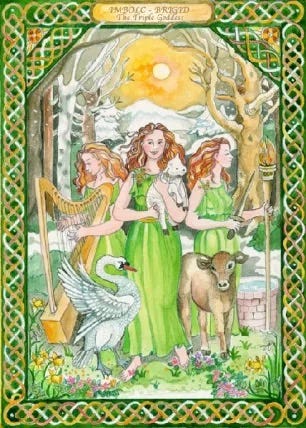
Let us turn our gaze inward, toward the living flame that once burned bright in the hearts of our Gaelic ancestors, embodied in Brigid—the exalted one, the fiery arrow of inspiration and renewal. In the shadowed groves and mist-veiled wells where the old ways whispered secrets to those who listened, Brigid was no distant abstraction but a vital presence weaving poetry’s hidden codes, the healer’s touch, and the smith’s forge into the daily rhythms of life. Her essence spoke to the esoteric mysteries guarded by the filid and druids: knowledge passed mouth-to-ear in complex verse, inaccessible to the uninitiated, binding community to the sídhe and the turning wheel of seasons.
From the oral traditions captured in Sanas Cormaic, we hear her directly:
“Brigit, a poetess, daughter of the Dagda… the goddess whom poets adored… whose sisters were Brigit the healer and Brigit the smith.”
This triple flame—wisdom’s spark, body’s restoration, matter’s transmutation—reveals her as a bridge between worlds, her name echoing Proto-Celtic heights of sovereignty and the breo-saighead’s piercing light.
In the great cycles of Lebor Gabála Érenn and Cath Maige Tuired, she stands among the Tuatha Dé Danann, mourning Ruadán with the first keening that transformed raw grief into sacred lament, her protective beasts crying warnings to safeguard the herds and fields that sustained the people.

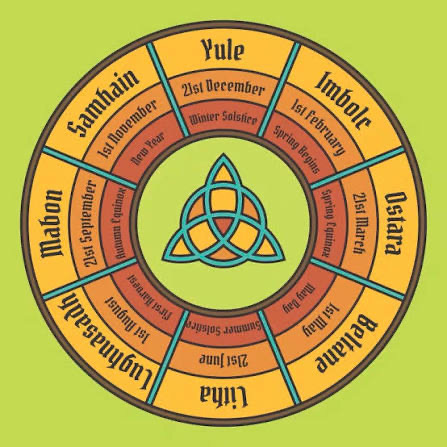
These were not mere stories but living esoterica. Poetry encoded genealogies, laws, and cosmic alignments for the filid; smithcraft alchemized ore in fire’s sacred crucible, mirroring inner forging of will; healing flowed through wells as portals to ancestral wisdom, where clooties and offerings opened visions. Imbolc, around the first of February, marked the esoteric threshold—ewe’s milk stirring in the belly of the land, serpents emerging in prophecy, milk poured in offering as purification awakened fertility—one of the four great festivals of the Gaelic year (Imbolc, Bealtaine, Lughnasadh, and Samhain) that anchored our ancestors’ sacred cycle of seasons.
No stone temples loomed; instead, the mysteries dwelled in oak groves as axis points to the otherworld, in hearth fires tended with reverence, in the oral continuum that kept Brigid’s guardianship alive within the folk soul.
Yet this world of autonomous spirit faced an incursion that shattered its harmony. Christianity arrived not as gentle revelation but through calculated pressure on kings and elites, rippling into mass shifts laced with confrontation. Patrick and his successors lit rival fires on sacred hills, cursed druidic rivals, felled ancient trees pulsing with druidic power, and razed idols. Brehon laws bent toward the new creed, pagan authority waned under social coercion—loss of standing, land, communal voice—while monasteries rose as new strongholds amid the old tribal strife. The incoming faith promised stability but demanded the erasure of feminine divine sovereignty, replacing the pre-Christian duality where feminine and masculine forces intertwined in balance—neither dominating the other, as Brigid’s creative fire complemented the Dagda’s strength—with a rigid patriarchal monotheism enforced by male clergy and a singular male god.
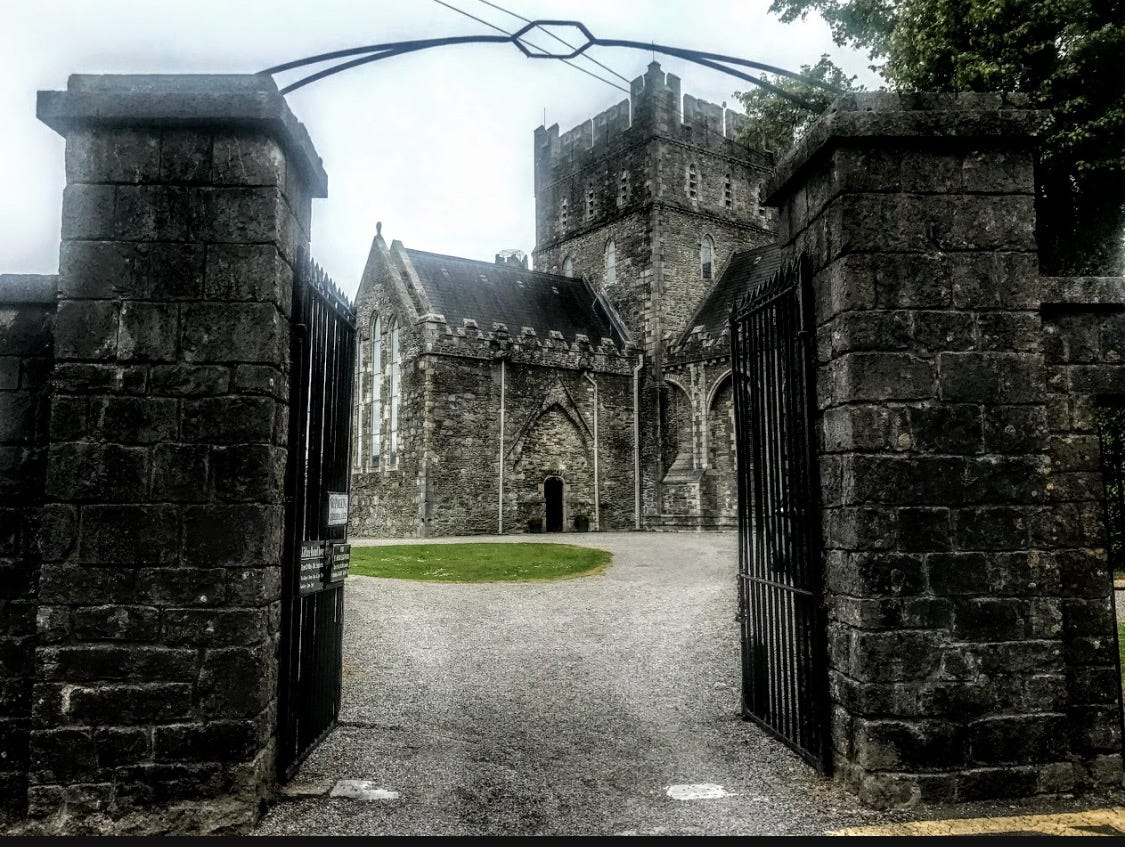
Kildare Cathedral (Cill Dara), the site where the monastery rose over the sacred oak and where the perpetual fire once burned.
At Kildare, the Church seized the moment with precision. Over the oak—symbol of druidic axis (Axis mundi) and likely a site already humming with Brigid’s presence—they built the double monastery under Saint Brigid, the historical abbess whose vitae by Cogitosus mirror the goddess too closely to be coincidence: multiplying milk and butter for abundance, shielding livestock, commanding weather, healing as “Mary of the Gaels.” Her feast swallowed Imbolc whole, part of the broader Christian takeover of the four Gaelic festivals.
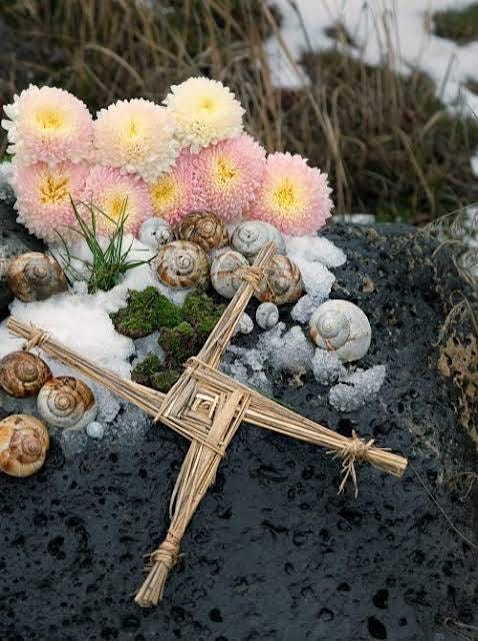
The people’s rites—woven crosses (at the crossroads) guarding against fire and ill, Brídeóg dolls carried in procession, wells visited for blessings, offerings left for her “visit”—survived only by having their origins snuffed out, repackaged as devotion to a humble virgin saint. Folk wisdom, once a living esoteric thread to the old gods, became a manipulated tool easing conversions among the wary.
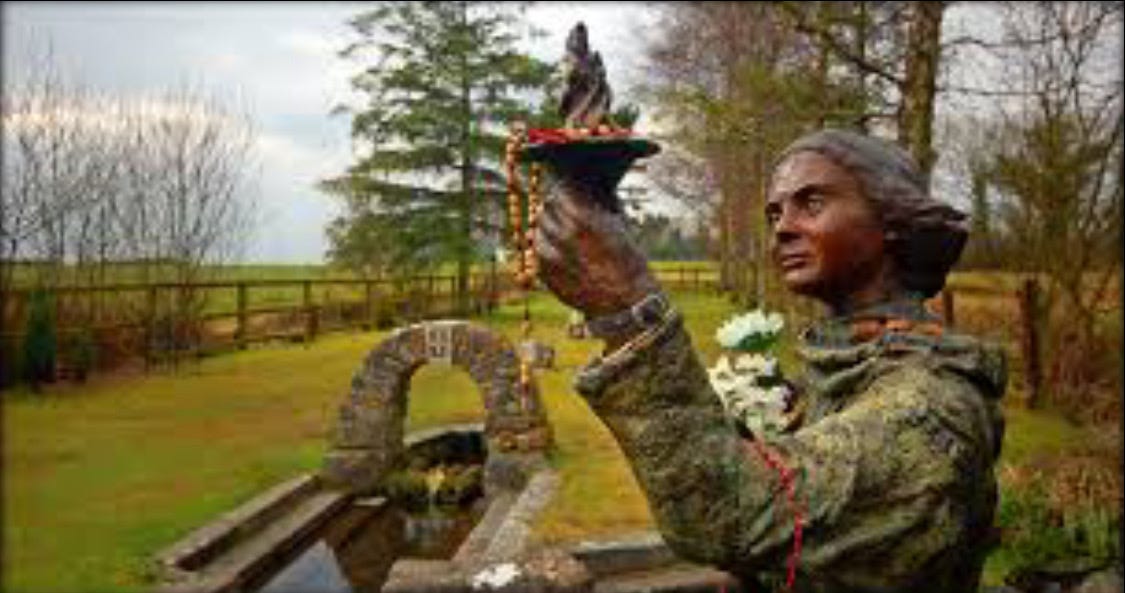
Brigid’s Holy Well (Tobar Bríde) at Kildare – statue with clootie offerings
This syncretism served as a strategic “pagan cover”: by grafting goddess attributes, name, date, site, and rites onto a (likely real) Christian abbess portrayed as humble virgin/miracle-worker, the Church made conversion familiar and palatable, easing elite buy-in and reducing resistance amid coercive pressures—site repurposing, druid confrontation, legal and cultural suppression.
It distorted and erased the independent polytheistic goddess, taking the living folklore of our ancestors and reshaping it not as honored ancestral wisdom or balanced reverence for the old powers, but into idols demanding worship akin to their messiah—elevated intercessors placed between the people and the divine, stripping communal folk traditions of their autonomous roots and forcing them into a hierarchical cult of saints.
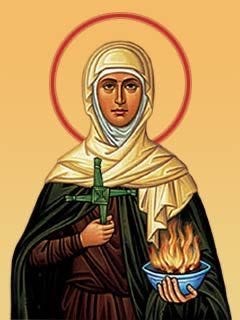
The perpetual fire at Kildare stands as a stark emblem of this appropriation and the people’s enduring resistance. Historians believe this was originally a druidic ritual tended for the goddess Brigid. The Church adapted it, keeping a perpetual fire by 19 nuns in honor of the saint (Brigid herself on the twentieth night), hedged against men in echo of priestess exclusivity. This late account by Gerald of Wales, tinged with exaggeration and absent from earlier saintly lives, overlays Christian “eternal light” upon the goddess’s hearth-flame or forge mystery. The site’s potency was claimed, reframed, and subordinated.
Attempts to end the practice began in 1220 AD when Henry de Loundres, Archbishop of Dublin, issued an edict ordering its extinguishment, viewing it as “fire-worship” with pagan overtones; yet the local community and nuns relit it in an act of quiet defiance, allowing the flame to continue for centuries.
The final extinguishment came in 1540 AD during the Reformation, when under King Henry VIII’s orders and the Dissolution of the Monasteries, Archbishop George Browne of Dublin ensured the flame was permanently snuffed out as the religious house in Kildare was suppressed.
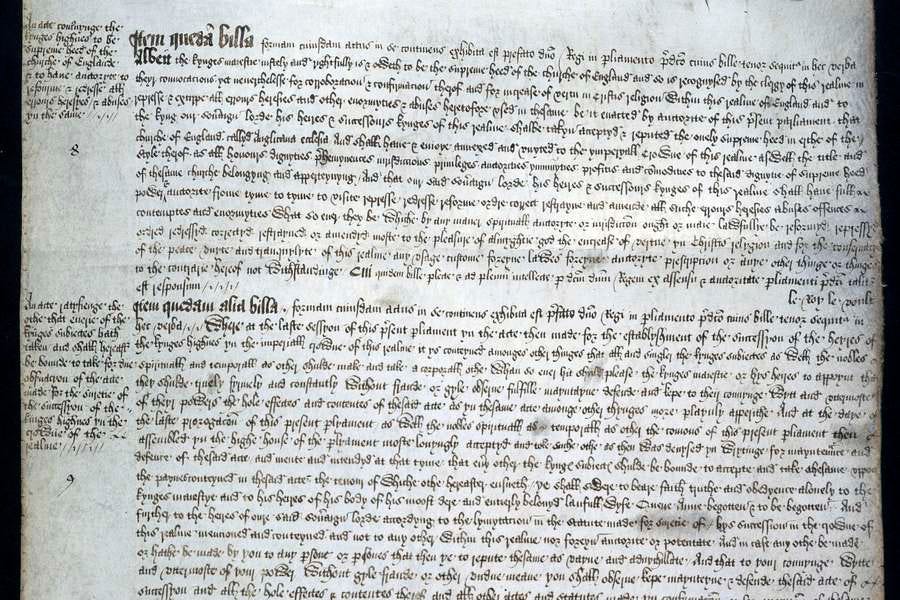
Original manuscript of the Act of Supremacy 1534 (C 65/143 m5), showing the opening text in medieval secretary hand on parchment.
This remarkable longevity—from the 5th-century arrival of Christianity to the 16th century—reveals how fiercely the people clung to these traditions, resisting full conversion for over a millennium despite official pressures and nominal Christianization by around 700 AD. Pagan-rooted folk practices endured deep into the medieval period, demonstrating that true spiritual transformation was slow, contested, and never entirely complete at the grassroots level.
In this philosophical light, the appropriation reveals its cold strategy. By grafting Brigid’s name, attributes, date, and communal folklore onto a Christian vessel, the Church manipulated acceptance amid coercion, transferring devotion while burying its pre-Christian roots deep. The autonomous goddess—embodiment of creative feminine fire, poetry’s seer, guardian of the folk—distorted into a saintly subordinate, her esoteric inheritance fragmented under monotheistic control. All traces of her independent worship come filtered through Christian scribes; the original flame dimmed as institutional dogma rose.
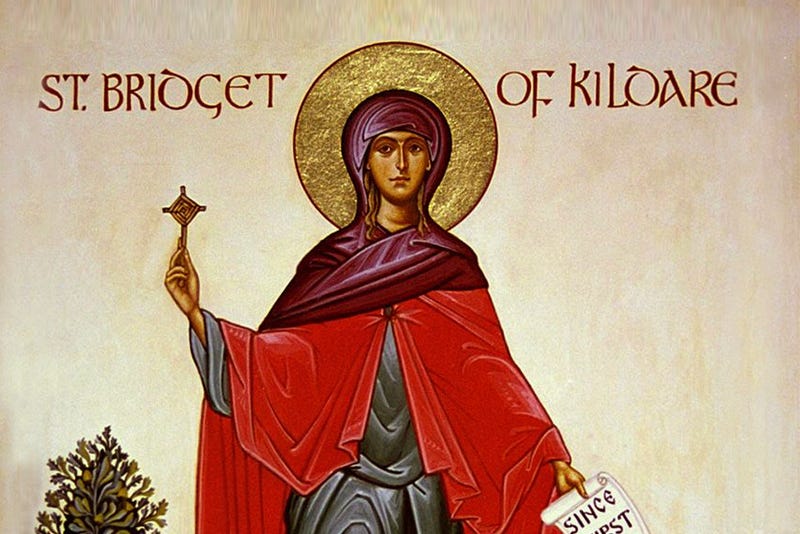
This history lays bare the falsehood that Christianity “saved” White European culture. Our ancestors’ ways—esoteric, animistic, honoring the duality of divine feminine and masculine in balance, as seen in Brigid’s triple flame alongside gods like the Dagda—were not preserved but dismantled with sword-like force: groves destroyed, druids displaced, cosmology overwritten by an imported theology that prioritized male hierarchy and centralized power.
What endured was a shadow, folk practices stripped of origins to serve conversion. The true resilience lies in remembering: in neopagan revivals, in the blood-memory of Imbolc’s stirrings, in honoring Brigid as she was before the overlay. Let us reclaim that unextinguished spark, honoring the old mysteries against the erasure that sought to claim them.
⚡️🤍⚡️